
The best fall kayaking in northern Illinois runs from late September through the third week of October, and peak color near Rockford typically lands between October 10 and October 24. The most reliable foliage paddles are the Rock River from Beloit to Rockton, and the narrow, tree-canopied Kishwaukee River through Espenscheid and Kishwaukee River forest preserves. Both are short, beginner-friendly floats, and both are reachable with a rental and shuttle from Rocktown Adventures at 313 N. Madison Street in Rockford.
Here is when to go, where to launch, and what to bring.
Why fall is paddling's best-kept secret
Summer gets the crowds. Fall gets the good water. From late September through October, the rivers around Rockford quiet down in every way that matters. Powerboat traffic drops off after Labor Day. Bugs are gone. Air temperatures in the 60s and low 70s beat an 88-degree July afternoon for paddling comfort, and water levels on the Rock and Kishwaukee are usually stable and clear once the summer algae fades.
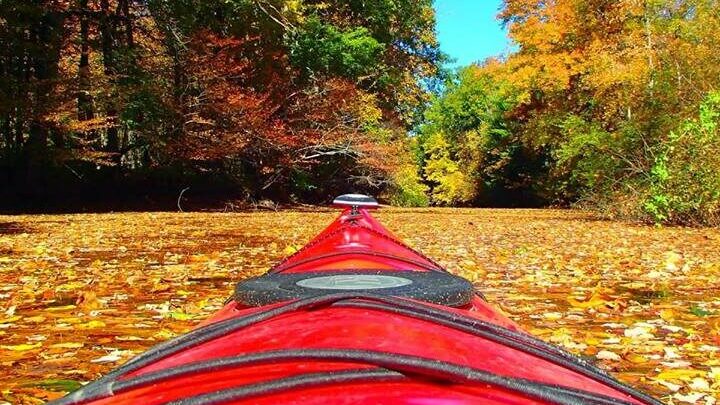
And then there is the view. A river is the only place you get to look up at a fall canopy from underneath it, with the whole thing mirrored on the water ahead of you. Silver maples, cottonwoods, and river birch line these banks specifically because they like wet feet, which means the color is concentrated exactly where you are sitting.
Wildlife picks up too. October is migration season on the Rock River flyway — expect great blue herons, egrets staging before they head south, wood ducks in the backwaters, and bald eagles moving in as the weather cools. The tradeoff: the window is short and the water is getting cold. Plan around both.
When do fall colors peak in northern Illinois?
Fall colors in northern Illinois normally peak in mid-October. The Illinois Department of Natural Resources puts peak for the northern third of the state at roughly mid-October, with the first color showing up in northern counties by late September. In the Rockford area, that usually means the best paddling for taking in the outdoor kaleidoscope falls in the October 10–24 window, with October 13–19 the single most reliable week. We will be on the Kishwaukee River Oct 17!
| Window | Typical color | What you'll see on the water near Rockford |
|---|---|---|
| Sep 20 – Oct 4 | 10–25% | First turners: sumac, ash, black walnut, and Virginia creeper on the banks. Mostly green canopy with red accents. |
| Oct 5 – Oct 12 | 30–60% | Maples ramp up fast. Good color, fewer people, warmer water than peak week. |
| Oct 13 – Oct 24 | 70–100% — PEAK | Sugar and red maples at full color, cottonwoods gold, oaks turning. Best photography window of the year. |
| Oct 25 – Nov 5 | Past peak | Oaks hold rust and bronze. Canopy thins, which opens up long views down the river corridor. |
Two caveats worth knowing. First, these dates shift by up to a week in either direction depending on the year — a warm, wet September pushes peak later; an early cold snap pulls it forward. Second, a hard wind or heavy rain during peak week can strip a canopy in two days. If you want peak color, book a flexible date and watch the forecast rather than locking in a month out.
Best spots to see fall colors by kayak near Rockford
All of the stretches listed are point-to-point floats using Rocktown's shuttle service, so you paddle downstream and finish at the shop instead of fighting your way back upriver. Shuttles require 24 hours' notice and advance registration, and weekend availability varies.


Rock River — Martin Park to downtown (1–1.5 hours)
The shortest and easiest option, and the best pick if you have kids along or a tight afternoon. Wide, slow water with developed and wooded banks alternating the whole way. Shuttle is $5 per person, $20 minimum.
Best for: first-timers, families, a quick after-work color run.
Rock River — SportsCore II to downtown (1.5–2 hours)
The sweet spot for most fall paddlers. Long enough to feel like a real trip, short enough that you are off the water well before the light goes. More continuous tree cover than the Martin Park stretch. Shuttle is $10 per person, $30 minimum.
Best for: the classic Rockford fall-color float.
Rock River — Harlem Street to downtown (2–2.5 hours)
The longest Rock River run Rocktown shuttles. More time on the water, more wildlife, and the best odds of a long uninterrupted stretch of color. Shuttle is $15 per person, $40 minimum.
Best for: confident paddlers and photographers who want time to stop and shoot.
Kishwaukee River — the quiet one
If you want the postcard version of fall paddling in northern Illinois, take the Kishwaukee. It is narrower than the Rock, which means the canopy closes over the water in places and you are paddling through the color rather than past it. Rocktown shuttles three Kishwaukee put-ins:
| Launch | Paddle Time | Shuttle |
|---|---|---|
| Kishwaukee River Forest Preserve | 1.5–2 hours | $10/person, $40 min. |
| Espenscheid Forest Preserve | 2–2.5 hours | $10/person, $40 min. |
| Bauman Park | 2.5–3 hours | $15/person, $50 min. |
Best for: intimate canopy views, wildlife, and photos. The Kishwaukee is generally shallower than the Rock, so check current conditions with the shop before you book a late-season trip.
Sugar River
Rocktown also runs Sugar River trips. The Sugar is small, twisty, and beautiful in fall — a genuinely different experience from the Rock. Because it runs off-site, it takes more planning; call the shop at (815) 636-9066 to set one up.
What to wear for fall paddling
The short version: dress for the water temperature, not the air temperature. Rock River water typically slides through the 50s during October and into the 40s by early November. A 68-degree afternoon can hide 52-degree water, and 52-degree water will take your breath away if you go in.
A workable fall layering system:
- Base layer: synthetic or wool. Never cotton — wet cotton pulls heat out of you fast.
- Mid layer: fleece or a light insulated top.
- Outer layer: a paddling jacket or splash top to block wind and spray.
- Feet: neoprene booties or wool socks inside closed-toe shoes.
- Head and hands: a warm hat and paddling gloves once air temps drop into the 50s. You lose a lot of heat through your head.
- Dry bag: a full change of clothes, sealed, in the boat. Non-negotiable in fall.
- PFD: worn, zipped, and fitted over your layers — not stashed behind the seat.
Once water temperatures drop below about 60°F, layers alone stop being enough and you should be in neoprene base layers, a wetsuit or drysuit. We cover exactly where those lines are in our companion guide, Cold-Water Paddling Gear: What to Wear for Fall Kayaking & SUP, publishing September 26.
Guided fall-color trips with Rocktown
If you would rather not plan the logistics, we will. Rocktown runs guided paddling trips and custom private trips throughout the fall, including Turtle Creek, Sugar River, and a naturalist led paddle with Kane County Forest Preserve where a nature guide talks you through what you are looking at.
Guided trips are a good call for fall specifically, because the season's two complications — cold water and short daylight — are exactly the things a guide manages for you. We handle the shuttle, the route, the timing, and the safety gear. You paddle.
Rentals run $30 for two hours, $40 for a half day, and $55 for a full day on single kayaks and stand-up paddleboards. Tandems and canoes are $45 for two hours, $55 for a half day, and $65 for a full day. Fishing kayaks are $35, $45, and $60. Every rental includes a PFD.
Safety: shorter days and cooler water
Three things change in October, and all three are manageable if you plan for them.
1. Daylight disappears earlier than you think.
Sunset in Rockford drops to roughly 6:10 p.m. by mid-October and about 5:50 p.m. by month's end. Once daylight saving time ends on November 1, 2026, it is dark before 5 p.m. Plan to be off the water at least an hour before sunset and count backward from there when you pick a launch.
2. The water is colder than the air.
Immersion below 60°F triggers an involuntary gasp reflex in the first minute — that, not hypothermia, is the real danger. Wear your PFD, stay near shore, and dress to swim.
3. Debris moves after rain.
Fall rain brings down branches and strainers, especially on the narrower Kishwaukee and Sugar. Check conditions before you launch and give woody obstructions a wide berth.
Tell someone your launch point, take-out, and expected return time, and bring a phone in a waterproof case.
Frequently asked questions
When do fall colors peak near Rockford?
Fall colors near Rockford typically peak between October 10 and October 24, with October 13–19 the most reliable week. The Illinois DNR puts peak for northern Illinois at mid-October. Timing shifts up to a week either direction depending on the year's weather.
Is it too cold to kayak in October?
No. October is one of the most comfortable months to paddle in northern Illinois, with air temperatures often in the 60s. The caution is water temperature, not air temperature — Rock River water is typically in the 50s during October, so dress for immersion, wear your PFD, and pack a dry change of clothes.
What should I wear for fall paddling?
Synthetic or wool base layers, a fleece mid layer, a paddling jacket, neoprene booties or wool socks in closed-toe shoes, and a warm hat. Avoid cotton entirely. Once water temperature drops below about 60°F, add a wetsuit or drysuit. Always carry a sealed dry bag with a full change of clothes.
Does Rocktown offer guided fall-color trips?
Yes. Rocktown Adventures runs guided paddling trips and custom private trips through the fall. We also shuttle self-guided trips on the Rock and Kishwaukee Rivers with 24 hours' notice. Call (815) 636-9066 or book online.
Reserve your fall-color paddle before the leaves drop
Peak color near Rockford lasts about two weeks, and the best weekends book out. Reserve a rental, a shuttle, or a guided fall-foliage trip now and lock in your window.
Our fall trips this year are Oct 3,4, 10, and 17. You can find more information or register at:
https://rocktownadventures.com/events/.
Rocktown Adventures – 313 N. Madison Street, Rockford, IL 61107 · (815) 636-9066
Tuesday–Friday 10 a.m.–6:30 p.m. · Saturday 10 a.m.–5 p.m. · Sunday 11 a.m.–5 p.m. · Closed Monday (open by appointment)
